Showing posts with label The House. Show all posts
Thursday, August 16, 2007
Tuesday, August 7, 2007
Shazaam!
I'm still in and out of the lab. And, the photo gods are not ignoring my pleas. I have 2.99 prints from the tricky negatives. So, the printing is not utterly maddening. However, I can't share the images on the web. I tried printing my remembered fairy tale on 8 X 10 paper, but way too much information for that size frame. So, I jumped up to 11 X 14 and now it's not cramped and so busy. My dinky scanner can't fit that size print with the proper framing, so, you're out of luck.
The origins of the project came from my memory of being told a fairy tale (Sleeping Beauty) twice: the first tale would be the way white people would act out the tale; and, the second would be the way black folk would do it. If this was the 60s or 70s, I think I would have kept to that division of black and white. But, the time is the brand new Aughts, and some black people have achieved or acquired enough capital to not be excluded from mainstream American culture (this is a very debatable point with lots of shady corners to investigate, so I'm very aware of that, please, feel free to argue amongst yourselves).
I became less enamored of presenting a perceived white culture, and I realized it was more about the dominant trend of current American culture, commercialism. So, there are traces of black in the first fairy tale. Obviously, the "awkward/evil" fairy is a black hen, but I chose to make her an animal for two reasons. One, animal totems are used throughout many religions and spiritual practices. Even Christians use the "lamb" to symbolize an aspect of Christ. (My knowledge of Christianity is not thorough. Please, correct me when I err.) The second reason I chose an animal form for Ms. La-La is that "politically correct" white Americans will not say race is the source of their rejection/resistance/discomfort with non-Caucasians. They have been educated to encode their prejudice with variations of the thought "Why can't they be more like us?"
There are acceptable forms of blackness, especially if white corporate American can obtain a profit from them. That's why the "nice/good" fairy takes the shapely form of Beyonce. (This is no statement about Beyonce as a person or performer, I'm just using the carefully crafted persona that is put out there to sell records. I have paid $1.98 for two of her singles, and I feel perfectly entitled to handle that persona as I see fit...like a proper American, I've paid the fees to participate in her story.) I don't mean to say that the "nice/good" fairy is a sell-out, I'm presenting the other way to engage with the culture of the first fairy tale. Both fairies are negotiating with the culture: one does so on the culture's terms, the other on her own terms.
The other trace of blackness will appear on the handsome prince. If you examine him closely, you should notice that his hands are black but his head is white. I don't think it's a gross overstatement to say that young American males have usually appropriated parts of black culture to enliven their youth. It's an example of taking one part out of the whole to fit your viewpoint/agenda, and in America, you've probably "paid" for the privilege. (The misogynistic/gangsta style of rap is consumed primarily by white, suburban, male teenagers--why? Rap isn't just gangsta, it can't be defined by just that style.) The handsome young prince is also outfitted in togs designed by Ozwald Boateng, an immensely talented "bespoke couturier" born in Ghana and raised in London. You'd have to be a bit of a fashionista to see that, but it's there.
While working on the first fairy tale and discussing it with others, I also realized how "male" the dominant culture is in this story. Before the king marries the queen, her land is more pastoral and doesn't feature many buildings. After the marriage, tall skyscrapers and multiplying structures cover the fields of daisies.
While contemplating these tales, I had to confront my own American-ness and how we so easily believe we're the alpha and the omega. I realized that like so many of us, my childhood was shaped/infiltrated/tainted by Disney. I was remembering a fairy tale as presented by corporate America. It struck me (as they are hardly faithful or accurate in their retellings) that the original tale is European and that it was probably nothing like the Disney version or my memory. Researching it, I discovered, yes, there are many discrepancies between all of them.
Spinner's memory: two fairies only
Disney's version: three, I think
Perrault: 13 fairies
Spinner's memory: ends with marriage of Beauty and handsome prince
Disney's version: ends with wedding and happily ever after
Perrault: the marriage only concludes the second act, the third act is dominated by a wicked mother-in-law who is an ogress who eats children and hankers after her grandchildren
What they all have in common, though, is that Beauty is a mute object who is handled and moved through her story by others with a voice/power.
I'm almost finished with the first half of my project: portraying the remembered fairy tale. The second half of the project will be my portrayal of the re-authored version of Sleeping Beauty. And, this Beauty will not be a mute object, she's all mouth!
Sunday, July 29, 2007
Sunday, July 22, 2007
The first spire
I will create a bunch of spires like this for the roof of Baba La-La's house. Maybe the eyeball will make it into the finished product, maybe not. The size, shape and color of the spires should vary.
Get on your horsy,
Ride day and night,
Let the people know,
No need to fright:
THE SHRINKY DINKS ARE COMING!!
Ride day and night,
Let the people know,
No need to fright:
THE SHRINKY DINKS ARE COMING!!
Rapunzastiltsken - How to turn plastic into yarn
- Lay a plastic bag down flat. Handles should be to the right. Cut off the bottom of the bag so you get rid of the seam.
- Tightly roll up bag like sushi.
- Cut up roll. Try to keep widths uniform.
- Unravel your sliced mini-rolls. Snip them free so they have two ends.
- Tie your ends together to create continuous "yarn."
- Spin the "yarn" around your hand to form skein.
- I found the 10-J hook best for handling yarn that falls within a 1/4" - 1/2" strip. The 10.5 - K was way too big and unwieldy for me. However, I just learned how to crochet this morning.
- For my first effort, I didn't cut off the ends of my knots when joining together my strips. It can make the going a little fussy, but it does create an interesting (yet, sloppy) effect. The second go-around, I cut off the tie-ends to see if the stitch shows up better.
- Cut off the bottom of the bag. Otherwise, you get double-helix strips, which are too much trouble to trim.
- After hours of no real trouble, my first stitch snapped apart. I let out a primal scream (but, silent scream: no loud audio at the marble counter), tied the snapped ends into a new knot, and moved on.
An article in the magazine Craft described an artist, Alexis Berger, who is using plastic bags to make purses and slippers. Her process was not clearly described, so I winged what I did. But, she definitely got my ball rolling. Links to the magazine's website and Alexis' picture gallery are below.
Saturday, July 21, 2007
Tuesday, July 17, 2007
Bendy Thoughts
Inspiration for this room came from a book of images I pasted together when I was a devotee of all magazines related to interior design. I didn't want to get too fancy as I don't draw, but merely doodle. The face around Ms. La-La's window is based on a fabulous fireplace that exists somewhere in the world. The real-life fireplace's visage could be a beast or the anthropomorphization of the North Wind. Ms. La-La's window is most definitely a lion.
One of my childhood nightmares was the appearance of a giant tiger's head, whose jaws were agape, in my schoolroom. Someone would have to walk into those jaws, and the job always fell to me. I always woke up in a cold sweat.
I drew the eyes, nose and cheeks for a guide, everything else is freehand. I cut paper into strips, and edged them with a black Sharpie. Wielding a hot glue gun, I adhered these strips to La-La's wall at a ninety-degree angle. The crystal, sparkly bits are the sloppy remains of my glue. The paper is either glued into a spiral or it just undulates. Some strips are not glued all the way down; they were then made curly by running them across scissors' edge.
When I worked at Children's Hour in New Orleans, one of my favorite tasks was to wrap up birthday gifts and curl up buoyant bouquets of ribbon. One woman shocked me with the curt command to not curl the ribbon. She posited that too much attention is given to children's egos, and she had no desire to puff up anybody without cause. If embellishing a few ribbons to brighten up a birthday package is the first stone in the path of society's ruin, then you'll find me on a roof gleefully curling while Rome burns. People are so strange.
The walls were inspired by how some Africans decorate their make-shift homes in the slums surrounding cities. They take discarded refuse and packaging, then paper their walls in patterns that are still aesthetically pleasing. This follows the tradition of Africans decorating their homes with whatever is at hand, using pattern and shapes to encourage the eye to dance. Ms. La-La's walls are papered with discarded newspapers and then blotted with watercolor.
I have delightfully discovered that googling my evil fairy's name will reveal that there is a picnicking area in South Africa that bears her name as well as a city in Mozambique. Plus, there might be an Asian goddess that shares her honorific.
La-La's tub is very plain. Just a Sharpied outline on the paper. It's her vessel where she might observe, soak up or receive truth. So, I wanted to keep it pure. It's also a nod to the mighty Shel Silverstein, whose drawings and poems made me belly laugh as a child.
Curiously enough, another recurring dream from my childhood occurred in a Silverstein landscape. Of course, it was a white void. I was myself and full-blooded. A froward brat with a bouncy bun on my head in red corduroys. But, everything else was drawn in the squiggly black lines of nonsense modern. Two animated alligators were chasing me relentlessly. During my flight, I came across the instruments of the playground: see-saw, merry-go-round, swing set, monkey bars, and the highest slide I had ever imagined. I was "scared" but the good kind of scared as experienced by thrillseekers on certain rollercoasters. I ran for my life, and I laughed all the way.
The bookcase itself is drawn. But, the titles within it were typed up on the finest paper available. The thread count of this paper was absolutely royal. I collected poems, nursery rhymes, and book and song titles. All of them have significance and were carefully chosen. I then cut their words up to fit the spines that could be shelved in the case. This picture just shows the books in the case. Like any true booklover, La-La has piles of books everywhere waiting for her attention.
An excerpt from an obituary for Angela Carter
"She was the opposite of parochial. Nothing, for her, was outside the pale: she wanted to know about everything and everyone, and every place and every word. She relished life and language hugely, and revelled in the diverse."
The Observer 1992
Sunday, July 15, 2007
Please, Step Into Her Parlour
BaBa La-La exists in two worlds. No particular reason commands this duality; it just is. Left to her own devices, Ms. La-La would live in a treetop among swaying branches and dance with her cousins, the Four Winds. She would bat her lashes at the stars and hum with the planets, but still would gossip with spiders and squirrels through her tree trunk with its roots firmly planted in the ground.
Neither of La-La's worlds allows her those heights. She is destined to roll along bound to the earth. Not many creatures can claim to know they live in different worlds. All of us do, but we don't realize it. BaBa La-La has the ability to see her two worlds at once. She sees other curiosities as well, and cannot help telling those around her about the marvelous sights to which she is exposed.
In one world, the creatures there respect and welcome Ms. La-La to their hearths. They know they are sure to hear wonder stories. These wights scrape together their existence and welcome edifying points-of-view when the time to sing, dance, and laugh comes. In the other world, the beings that live there don't worry so much about how to live. Accumulating goods and adorning oneself dominate their polite conversation. While Ms. La-La is a well-mannered hen, she is not particularly polite and inept at the niceties. The dolls of this land tend to avoid Ms. La-La as she refuses to conform to their ways.
In the Land of the Dolls, Ms. La-La tumbles about their manicured hills in a ratty cardboard box. The outside is rough and shabby, but inside is a good ol' nest for a wise hen. She has appointed her magic cardboard house with bits and scraps found in her travels. When not lolling around on her make-believe pillows, she slumbers in a tub. When she needs a view, she looks through the mouth of a lion. Ms. La-La has a bookshelf that spits out portfolios at exactly the right moment.
When in Scratch Valley with the wights, well, that's another day...
Wednesday, July 11, 2007
Make-Believe Pillows
Suddenly, I became a seamstress. I'm an excellent dishwasher; I scrub porcelain until it sings; my Dyson and I have just celebrated our first anniversary; and, of course, I cook and mix concoctions. All of the other finer points of domesticity escape me. I have a particular fear of needle and thread. Exhibit A: The Quilting Incident at Charles Drew House, 1989. Enough said.
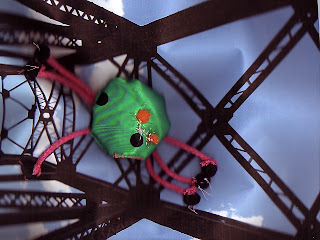
Back against the wall, I turned to my mother. While she raised me in thunderstorms, big ships and foreign lands, her childhood in Wisconsin was much more traditional. She spent time on a farm and often mentions her time in the Brownies. My logic was: if you know how to milk a cow, you know how to sew a pillow. She seemed like she knew what she was talking about. Here are the steps I was given:
- draw matching shapes out on fabric
- cut around lines, leaving a 1/4 inch leeway
- face the exteriors inwards and pin together
- stitch along lines, stopping an inch away from completion
- turn pillow cover inside out
- stuff with toilet paper
Her Mother: "Oh, I've never made any pillows."
Spinner: "What?! How did you know all this stuff?"
Her Mother: "I've watched them do it a million times on Trading Spaces."
Spinner: "What?! How did you know all this stuff?"
Her Mother: "I've watched them do it a million times on Trading Spaces."
So, my pillows have inch-long scars where they were finished off with my clumsy fingers. My mother comforted me with the words, "No one's going to actually sleep on them. It's OK, they're only make-believe pillows."
Monday, July 9, 2007
Start the Grand Tour
This summer was supposed to be all about sin. I wanted to explore how one culture could perceive a certain trait as a weakness, and another culture could take it and turn it into a strength. The first thread was the language of blues women and their pride and satisfaction in being "evil." Most people wouldn't want such a reputation. But, in my world, "evil" means not only strength and power, but the willingness to use that strength. How wicked you were depended on how much you acknowledged your dirty work.
There once was a girl,
Who had a little curl,
Right in the middle
of her forehead.
When she was good,
She was very, very good.
But when she was bad,
She was evil incarnate.
Guess who? My plan was to stage scenes illustrating the split between those who own their sin and those who shun their darkness. I spent a lovely afternoon in the library discovering ideas that could influence my pattern. My favorite of the day was "Self-knowledge for anyone means knowledge of sin." Aaah. I'm fairly sure I lifted that from an amateur web page that earnestly contemplates sins and virtues, but I cannot cite the source. While surrounded by Dante, C.S. Lewis, and fascinating symbols, I jotted down my own thought: "The audacity of creating your own narrative when the threads of fate do not support that weft. Cutting these threads & starting anew."
I was reminded of how I would be told "Sleeping Beauty" twice. The first telling would follow the traditional story: king and queen have baby, throw party, don't invite the "evil" fairy, bad fairy curses baby, curiosity makes baby sleep for eons until handsome boy kisses her on cheek. Instead of wrapping up the story with "And they lived happily every after...," my lesson included the bridge, "That's how white people do it. Now, this is how black folks do it." And instructions on how to rule the world would follow. I thought images of these dual stories/tellings would be good bread to support my peanut butter-and-jelly project of sin.
But my duelling fairy tales intrigued me more and more. So, my summer is less about sin and more about "making." I'm constructing the first fairy tale using photo montage--my materials are commercial images lifted from magazines, websites, and my own photo library. They're easily recognizable and usually whole, intact. By that, I mean you shouldn't be able to see the seams. You recognize the choice, but you don't see the craft. (Example: When a person walking down the street is wearing Abercrombie & Fitch from head-to-toe, you recognize their choice to be identified with what that brand means. But, you don't dwell on how their look was constructed because it was appropriated from a catalogue or mannequin. When you see a person who mixes and matches seemingly disparate clothing, you wonder how they did it and how did they know to do it. Or, at least I do.)
My second fairy tale is all about exposing the seaming and not tucking away the knots. The common thread between the two tales is the "evil" fairy who I have named Baba La-La. She's a black hen with an afro. She's got a lion's booty and ostrich gams. I'm building her dwelling that appears in the first fairy tale. It's a two-dimensional (more often than not) home to fit the flat world of the traditional story. But, as she's Baba La-La, it's hard to keep this witchy hen completely horizontal and depressed. More images from her house and the worlds she inhabits will be posted to this blog. As well as more earnest contemplations about the loveliness of sin.
I was reminded of how I would be told "Sleeping Beauty" twice. The first telling would follow the traditional story: king and queen have baby, throw party, don't invite the "evil" fairy, bad fairy curses baby, curiosity makes baby sleep for eons until handsome boy kisses her on cheek. Instead of wrapping up the story with "And they lived happily every after...," my lesson included the bridge, "That's how white people do it. Now, this is how black folks do it." And instructions on how to rule the world would follow. I thought images of these dual stories/tellings would be good bread to support my peanut butter-and-jelly project of sin.
But my duelling fairy tales intrigued me more and more. So, my summer is less about sin and more about "making." I'm constructing the first fairy tale using photo montage--my materials are commercial images lifted from magazines, websites, and my own photo library. They're easily recognizable and usually whole, intact. By that, I mean you shouldn't be able to see the seams. You recognize the choice, but you don't see the craft. (Example: When a person walking down the street is wearing Abercrombie & Fitch from head-to-toe, you recognize their choice to be identified with what that brand means. But, you don't dwell on how their look was constructed because it was appropriated from a catalogue or mannequin. When you see a person who mixes and matches seemingly disparate clothing, you wonder how they did it and how did they know to do it. Or, at least I do.)
My second fairy tale is all about exposing the seaming and not tucking away the knots. The common thread between the two tales is the "evil" fairy who I have named Baba La-La. She's a black hen with an afro. She's got a lion's booty and ostrich gams. I'm building her dwelling that appears in the first fairy tale. It's a two-dimensional (more often than not) home to fit the flat world of the traditional story. But, as she's Baba La-La, it's hard to keep this witchy hen completely horizontal and depressed. More images from her house and the worlds she inhabits will be posted to this blog. As well as more earnest contemplations about the loveliness of sin.
Subscribe to:
Posts (Atom)